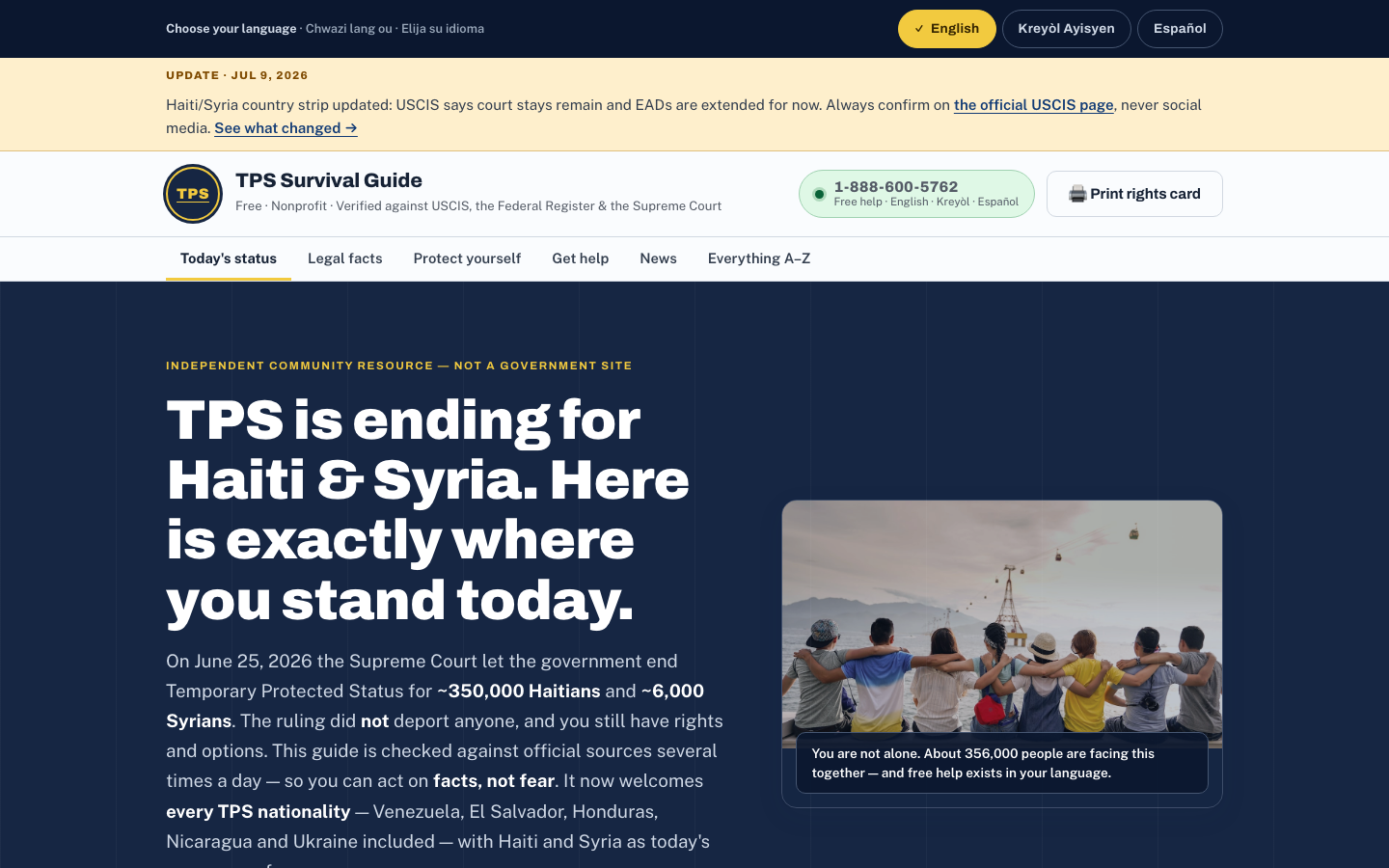
Re-verified 3× every day
Today's Status
Plain answers to the questions people are scared to ask: Can I still work? Have deportations started? Every card carries its source and the time it was last checked.
Visit the status board →My name is Micah Berkley. I built TPS Survival Guide in Miami — a free, trilingual, self-updating information lifeline for families living under Temporary Protected Status. It verifies the law against primary sources three times a day, publishes in three languages, and collects zero personal data. This page is the whole story — for government, for nonprofits, and for the press.
After the June 2026 Supreme Court ruling on Temporary Protected Status, I watched something that didn't sit right with me. Around Miami — home to the largest TPS community in America — people were making kitchen-table decisions with lifelong consequences: whether to quit a job, pull a child from school, or hand cash to a stranger promising "a new program." And they were making those decisions based on a date they heard secondhand.
The real answer existed — buried in federal registers, court dockets, and agency pages that change without warning, written in a language many families don't read. The wrong answer was free, viral, and in their language. So the wrong answer was winning.
I decided the right answer should move faster than the rumor. I built this site, funded it myself, and pointed it at one job: verify the truth against the primary source, then hand it to the people who need it — in their language, for free, without asking who they are.
Micah BerkleyFounder, TPS Survival Guide — Miami, Florida
Every claim is checked against USCIS, the Federal Register, and court records — and cited. If we can't verify it, we say "unverified" instead of repeating it.
English, Haitian Creole, and Spanish — with machine-assisted translations clearly labeled until a native speaker reviews them. Dignity includes honesty.
No accounts, no forms that store identity, no ads, no tracking. Even our community board needs only a screen name — never a name, email, or phone number.
Thirty-six pages, three languages, checked against the government several times a day. Here are the four rooms of the house.
Plain answers to the questions people are scared to ask: Can I still work? Have deportations started? Every card carries its source and the time it was last checked.
Visit the status board →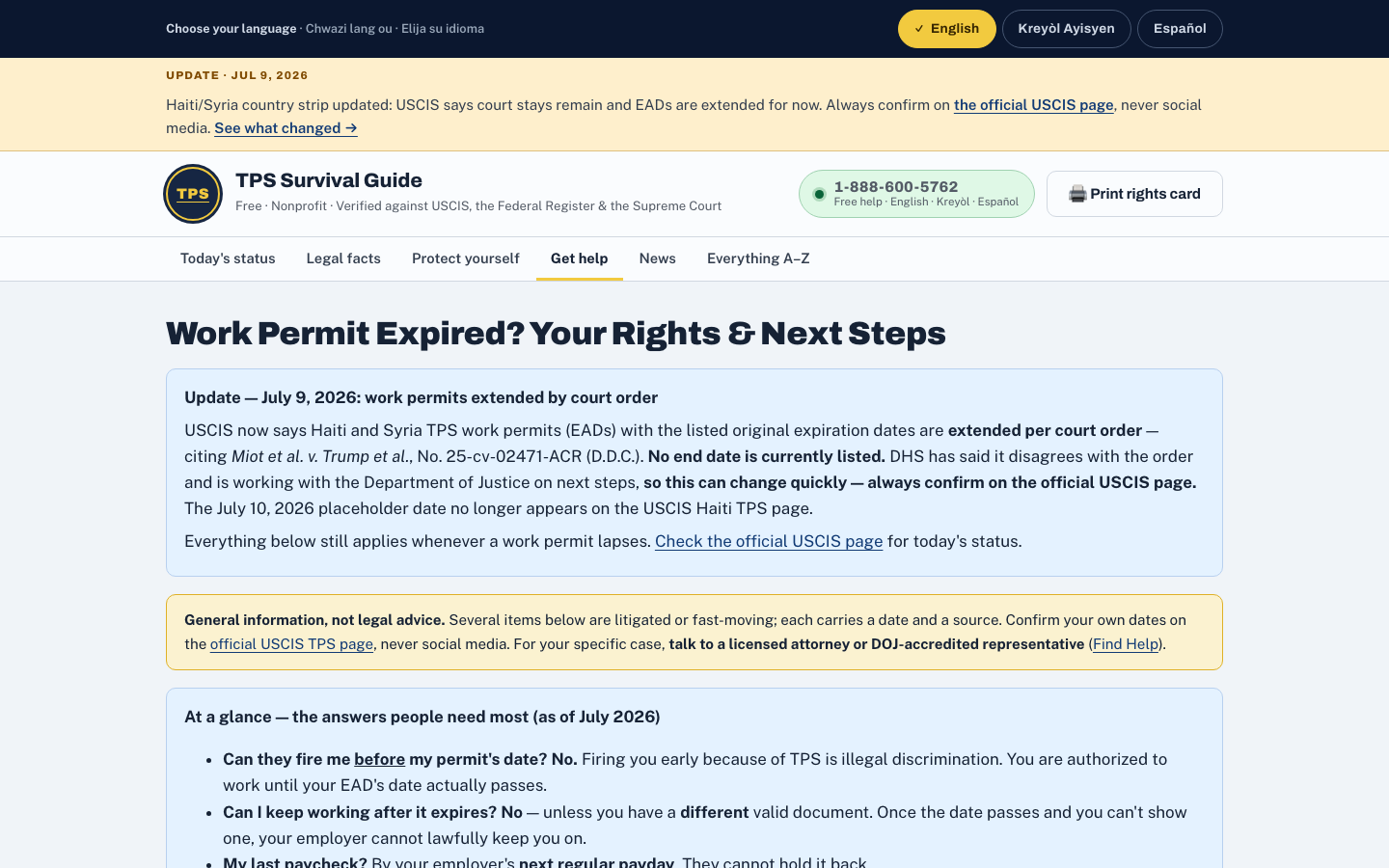
What happens if your work permit lapses — your rights with your employer, food, housing, childcare, and driving. Honest even when the honest answer is hard.
Read the guide →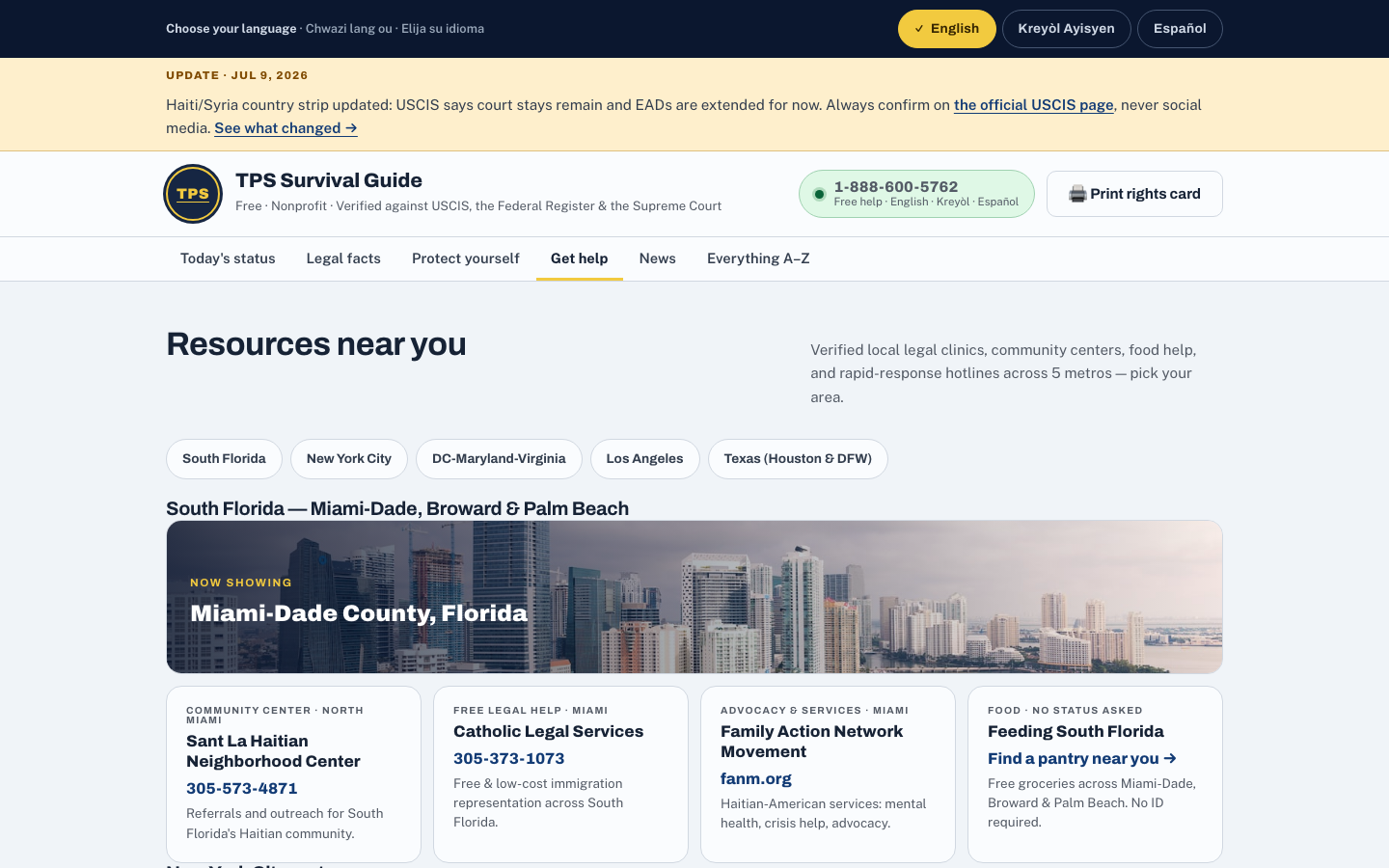
Every organization checked against its own live website — phone by phone. Dead links caught, rebrands corrected, and no number ever invented. Miami, NYC, DC, LA, Texas.
See the directory →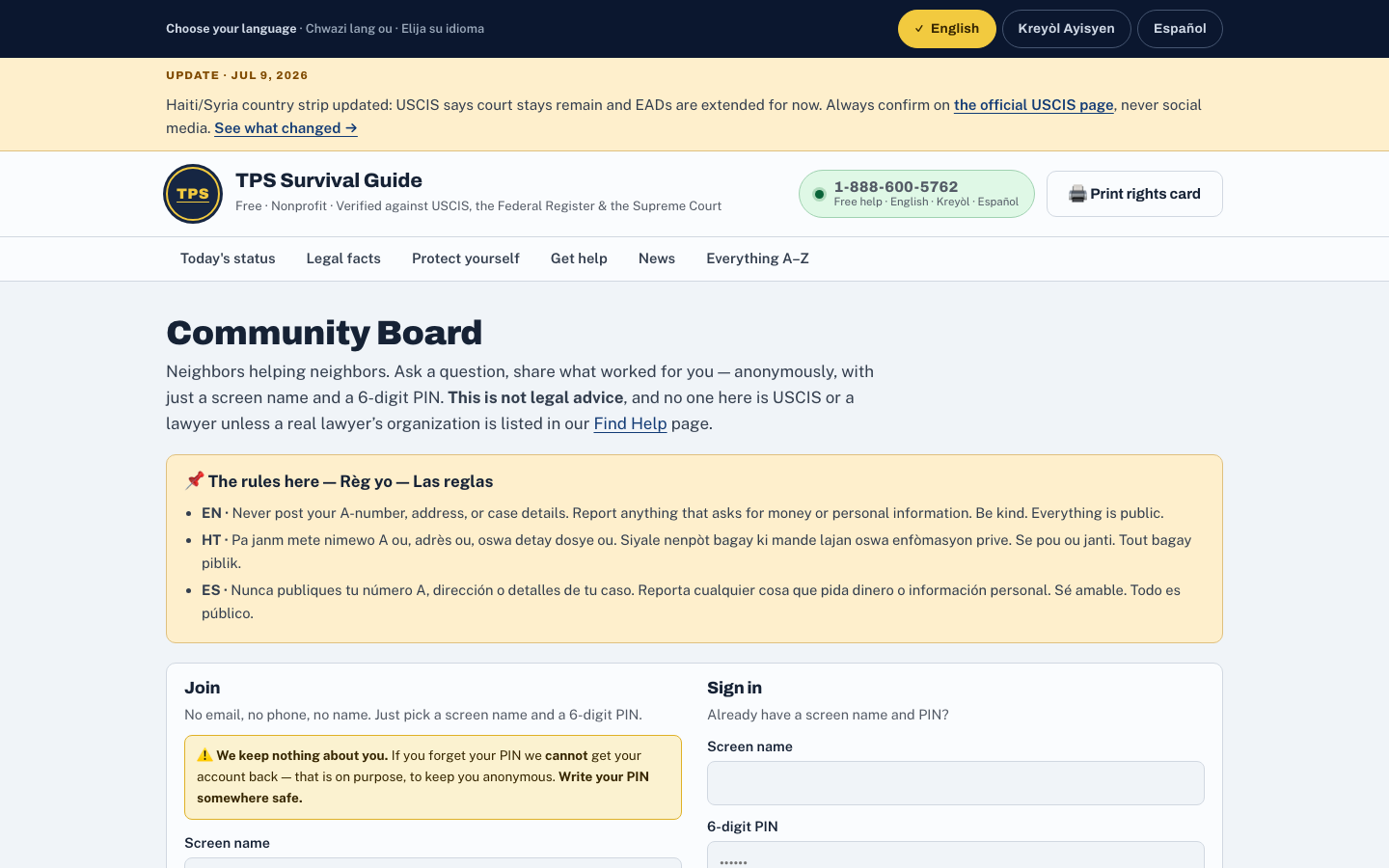
A place to share resources and ask questions without surrendering identity. AI pre-screening plus human moderation keeps scammers out; anonymity keeps families safe.
See the board →This is what makes it first of its kind: the site is not maintained — it maintains itself. Three times a day, an AI pipeline checks the government's own sources and rewrites the site only when it can prove the facts changed.
commit  ·  tps-status-bot
"Auto-update: status verified against primary sources

 Updated by the AI verification step. Guardrails: changes
 require citations from fetched uscis.gov / federalregister.gov
 content."

Every number on this page is checkable on the live site — sources and methodology here.
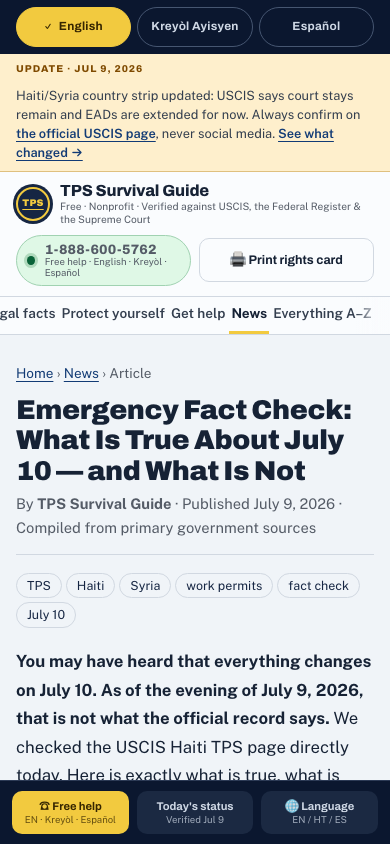
USCIS listed July 10, 2026 as the day Haiti and Syria TPS work permits could stop being valid. Hundreds of thousands of families — and their employers — were bracing for it.
On the evening of July 9, the date vanished from the USCIS page — replaced by court-order language from Miot v. Trump: permits extended, no end date listed.
My verification system flagged the change against the live source, and a verified fact-check — what's true, what's false, what to do — was published that night in English, Kreyòl, and Español, while the dead date kept circulating on social media.
Yes — that's exactly what it's built for. The project is nonpartisan, takes no political money, sells nothing, collects no personal data from your constituents, and clearly states it is general information, not legal advice, and not affiliated with any government agency. Linking or endorsing costs nothing and commits your office to nothing.
I do. It is completely self-funded — no ads, no sponsors, no grants pulling strings, no donations solicited. That independence is deliberate: nobody can buy what the site says. It is a nonprofit project (we do not claim 501(c)(3) status, and we ask you to describe us accurately).
Every claim is cited to a primary source — USCIS, the Federal Register, court records. An automated system re-verifies the site against those sources three times a day and is engineered to fail safe: if verification is uncertain, the site keeps the last verified truth rather than guessing. When facts change, we correct and date the change publicly.
Mostly, to send people your way. If you serve TPS families, your organization may already be listed in our verified directory — for free. If your details changed, or you're not listed, twenty minutes on a call fixes it. We're not seeking funding or a formal partnership; we're seeking accuracy.
Verified, primary-sourced facts you can check yourself; plain-language explainers in three languages; and a direct line to me, same-day: press@tpssurvivalguide.com. The July 10 story above is a good place to start — every beat of it is documented on the live site.
To whom it may concern,

[Office/Organization] supports the availability of accurate, multilingual,
freely accessible information for Temporary Protected Status holders in our
community. We have reviewed TPSSurvivalGuide.com, a free, nonpartisan,
self-funded information resource that cites official government sources and
collects no personal data, and we encourage residents seeking information
about their status to consult it alongside official sources such as USCIS.gov
and qualified legal counsel.

[Name, Title]
Adapt freely — no permission needed.
Published the night the deadline vanished, in three languages, while the rumor was still spreading.
Read it →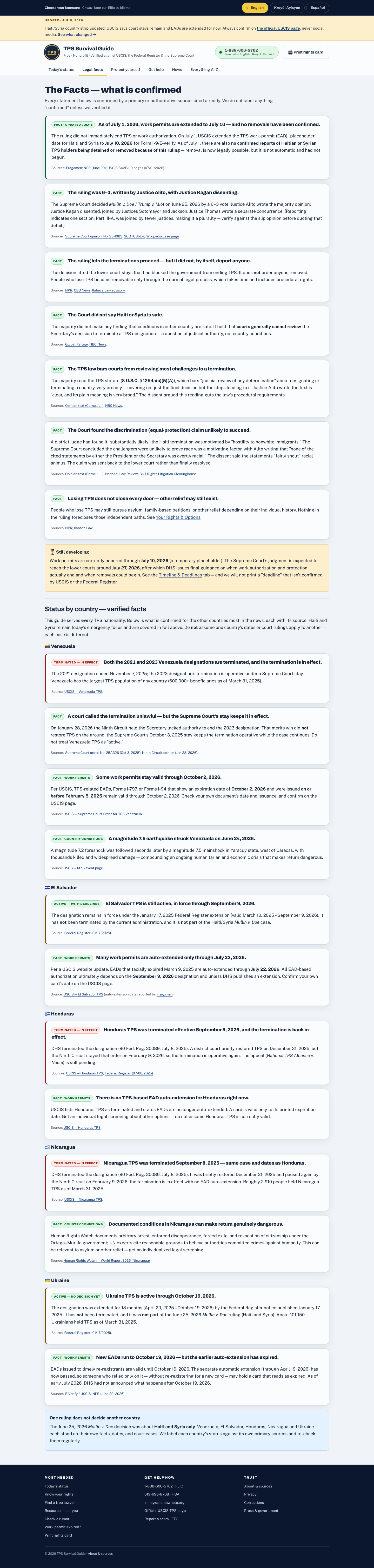
Haiti, Syria, Venezuela, El Salvador, Honduras, Nicaragua, Ukraine — each status verified and cited, including the June 2026 Venezuela earthquake, confirmed before we published a word about it.
See the facts →Green cards, asylum, and the paths that actually exist — including the deadlines that quietly die when a status ends. Written to inform, never to sell.
Read the guide →Whichever door you came through, the ask is small and the commitment is zero.
Your constituents are already calling, scared. Link the guide from your immigrant-services page, print the free trilingual rights card for your counter, or endorse it — no money, no data, nonpartisan.
Talk to MicahWe send people to you. Check your listing in the verified directory, correct it, or add your services — twenty minutes on a call is the whole ask.
Check your listingThe story is running whether it's covered well or not. Verified facts, trilingual materials, and a founder who answers same-day.
Reach the founderOr simply: press@tpssurvivalguide.com — it reaches me directly.